

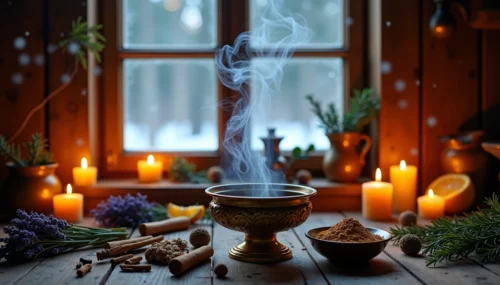
When it's cold, dark, and quiet outside, it's time to start burning incense indoors: herbs, resins, and fragrant spices that cleanse, protect, and warm your home and soul. This article takes you on a journey into the world of old home remedies, explains the significance of the Rauhnächte, and shows you how you can easily perform powerful winter incense burning rituals yourself.
Table of contents 📚
- Introduction
- Origin of winter smoking
- What do you need for smoking?
- Old home recipes and herbal mixtures
- Application and rituals in the home
- Conclusion
1. introduction 🌌
Smoking in winter is a centuries-old tradition in Central Europe, which is particularly practiced during the so-called Rauhnächte (rough nights) between December 21 or 25 and Epiphany (January 6). During this special time of the year, our ancestors burned herbs, resins, and needles to protect their homes from negative influences, purify the atmosphere, and consciously transition into the new year.
The art of incense burning combines deep spirituality with practical everyday knowledge. Every herb and incense has its own energetic quality: some plants cleanse and purify, others bring peace, protection, or new strength. This custom is still kept alive today, especially in southern Germany, Austria, and the Alpine regions—not only in living spaces, but also in stables and farm buildings.
When burning incense in winter, it is important to ensure that the room temperature remains comfortable and that you have the necessary equipment: fireproof containers, suitable charcoal or an incense burner, and selected herbs and resins. In this article, we will take a step-by-step look at old home recipes, the spiritual significance of this practice, and which winter herbs are particularly well suited for burning incense in the home.
2. origin of winter smoking 🕯️
2.1 Burning incense during the Twelve Days of Christmas
The so-called Rauhnächte (rough nights) form the heart of the winter smoking tradition. They originated from the difference between the lunar and solar years: the lunar year comprises around 354 days, the solar year 365 days – leaving a symbolic twelve „surplus“ nights. Depending on the region, the Rauhnächte begin on December 21 (winter solstice) or December 25 (Christmas Day) and end on Epiphany.
During this time, our ancestors would walk through their homes and stables with incense burners to dispel negative energies, ask for protection, and bless the coming year. Ancient traditions tell us that each night, a different aspect of life was considered and purified or strengthened with the help of incense.
2.2 Spiritual and cultural significance
For centuries, the Twelve Days of Christmas have been considered a period in which the boundaries between this world and the next are particularly permeable. The rising smoke is understood as a symbolic bridge between the material plane and the spiritual world. Burning certain herbs and resins is believed to release heavy or stagnant energies and invite more positive vibrations.
At the same time, burning incense serves to cleanse the soul: the scents sharpen the senses, promote intuition and mindfulness, and encourage reflection on the past year. Many people use this time to consciously pause, let go of the old, and formulate new visions.
2.3 Why smoking is done in winter
Winter, with its natural darkness and silence, provides the ideal setting for incense rituals. Around the winter solstice—the longest night of the year—the symbolic energy of change intensifies: the old year comes to an end and a new one begins. During this phase, people traditionally stayed indoors more, and illnesses could spread more easily.
Smoking was therefore not only used as a spiritual practice, but also for practical purposes: herbs such as juniper were considered disinfectants in the Middle Ages and were used to ward off disease. To this day, the winter tradition of smoking combines practical benefits with deep symbolism for purification, protection, and new beginnings.
3. what do you need to smoke? 🪔
3.1 Basic equipment for smoking
You don't need complicated equipment to start smoking – a small, sensible basic set of equipment is sufficient:
- A fireproof incense burner (clay, ceramic, soapstone, or metal)
- Smoking sand as an insulating layer
- Smoking charcoal as a heat source
- incense tongs for safely holding the charcoal
- Optional: a mortar, a small metal spoon, and an incense burner
Traditionally, many incense burners have three legs – they symbolize the trinity of body, mind, and soul and also ensure a secure footing.
3.2 Fireproof containers and smoking charcoal
During winter smoking, the charcoal reaches temperatures of up to 400 °C. Therefore, the smoking vessel should always be placed on a fireproof surface and filled with a layer of smoking sand. Self-igniting incense charcoal is available in various diameters from approximately 2.7 to 5 cm. Smaller charcoal tablets are well suited for short incense burning sessions, while larger ones are ideal for extended rituals or a complete house cleansing. Depending on the size, the burning time is usually between 30 and 60 minutes.
3.3 Incense burners vs. charcoal
Incense burners are a gentle alternative to charcoal. Here, a tea light is lit under a metal sieve, on which herbs or resins are slowly heated. This produces significantly less smoke, but a fine, subtle fragrance—ideal for essential plants such as Lavender or for very high-quality resins.
However, charcoal is usually better suited for deep energetic cleansing and classic Rauhnacht rituals, as it produces more intense smoke and thus has a stronger effect in the room.
✨ Tip: High-quality resins for your winter smoking
Fine resins such as Frankincense – Boswellia sacra or natural local spruce resin. They can be used on charcoal or on a tea light warmer and go wonderfully with classic winter herbs.
3.4 Safety aspects of smoking
Safety always comes first when smoking:
- Never leave glowing coals unattended.
- Keep a sufficient distance from curtains, paper, and other flammable materials.
- Ventilate thoroughly after smoking so that the smoke dissipates.
- After the ritual, extinguish the charcoal not with water, but by smothering it with sand—this will keep the incense burner undamaged.
- It is best not to allow children and pets to be in the immediate vicinity of the smoke during intensive fumigation.
4. old home recipes and herbal mixtures 🌿
4.1 Smudging your home: Which herbs are suitable?
Herbs and resins are at the heart of every incense ritual. The following plants have proven particularly effective for powerful house cleansing:
- White sage – Intensive cleaning, especially for heavily soiled rooms
- Mugwort – one of the oldest incense plants in Europe, releases heavy energies
- Lavender – brings calm, peace, and harmony into the home
- juniper – protective, clarifying, traditionally used for disinfection
- Angelica, Thyme, bay leaf – strengthening and revitalizing
If you want to work with regional herbs, you could make your own bouquet from, for example Mugwort – Artemisia vulgaris A wonderful base for home fumigations.
4.2 Typical winter herbs: Mugwort, Lavender, Rosemary
Mugwort is considered the „mother of all herbs“ and is traditionally used to ward off negative influences and accompany transitions. Lavender Has a balancing, calming effect and promotes restful sleep. Rosemary On the other hand, it stands for clarity, concentration, and courage—perfect for starting a new year. In addition, the elecampane root with their warm, slightly vanilla-like scent, they dispel winter blues and lift the spirits.
4.3 Christmas spices: cinnamon, cloves, cardamom
Classic Christmas spices add a cozy, festive touch when smoked:
- Cinnamon – warms and creates a welcoming atmosphere
- cloves – deep, spicy, protective
- cardamom – opens the heart and lifts the spirits
- Star anise, mace, orange peel – round off winter blends aromatically
Combined with local resins such as spruce resin, it creates a fragrance that immediately evokes Christmas, open fires, and a sense of security.
4.4 Making your own incense blend
Making your own incense blends is easier than many people think—and it's great fun:
- Select a few high-quality ingredients (e.g., 2–4 herbs + 1 resin).
- Dry the herbs thoroughly and chop them coarsely.
- If necessary, freeze the resins briefly and then crush them in a mortar.
- Burn a small test mixture and check the fragrance effect.
- Store the final mixture in well-sealed jars in a dark, dry place.
4.5 Combinations with resins and needles
A proven basic ratio is three parts herbs to one part resin. Domestic resins such as spruce resin or so-called „forest incense“ give incense blends a grounding, woodsy note. Combinations of spruce needles, myrrh, and star anise are particularly suitable for winter incense burning.
Important: If there are too many herbs, the mixture can quickly char on the charcoal and produce unpleasant smoke. Resins ensure a softer, fuller fragrance and more even burning.
🌲 Winter fragrance for the home
For typical „winter forest“ blends, you can use, for example Spruce resin – naturally pure combine with dried spruce needles, a little mugwort, and a hint of cinnamon. A ready-made blend is also practical. Incense set – Rauhnächte, which contains the right blends and accessories for all twelve nights.
5. application and rituals in the home 🔁
5.1 Smoking clockwise – room by room
Traditional winter smoking follows a specific order. The ritual usually begins at the front door—the transition between the outside and inside worlds. From there, you move clockwise through all the rooms. Ideally, you start in the lower areas (e.g., basement) and work your way up, so that you symbolically „ascend“ with the smoke.
No corner should be left out: use a feather or your hand to direct the smoke into corners, behind cabinets, and under furniture. You can linger a little longer in places that feel particularly „heavy“ or „sluggish.“.
5.2 How long should you burn incense?
The duration depends greatly on the size of the apartment and the intensity of the ritual:
- A simple fumigation: a few minutes to about 20 minutes
- Comprehensive energetic house cleaning: 1–2 hours including ventilation phases
The exact time is less important than a conscious, calm process. Smoking should not seem rushed, but rather be experienced as a ritual that also gives you more clarity.
5.3 Smoking for purification and protection
Traditionally, comprehensive cleaning is carried out in several stages:
- Solution phase: Smoke counterclockwise with strongly cleansing herbs (e.g., mugwort, juniper, white sage) to release old and burdensome energies.
- Ventilation: Open the windows wide so that the smoke and released energies can escape.
- Harmonization phase: Use gentler, balancing herbs such as lavender, rose, or elecampane root.
- Protection phase: Burn protective plants such as juniper, laurel, or resin blends in a clockwise direction to anchor new, invigorating energy in the room.
5.4 Burning incense on special occasions (e.g., moving house, New Year's Eve)
Smoking rituals are particularly powerful:
- after moving house, to break old spatial habits
- after illness, arguments, or difficult times
- when you have an inner desire for change or a new beginning
- at the turn of the year or during the twelve Rauhnächte
Especially at the turn of the year, many people take advantage of a special Incense set – Rauhnächte, to dedicate each night to a specific theme—from reflection and gratitude to vision and realignment.
6. conclusion ✨
Smudging in winter connects us in a simple but powerful way to our roots and the knowledge of our ancestors. While cold and darkness reign outside, this ancient custom creates warmth, light, and a feeling of protection in our homes. The full power of the smudging tradition unfolds especially during the Twelve Days of Christmas, when the veil between the worlds is perceived as particularly thin.
With just a few items—a fireproof container, some charcoal, and carefully selected herbs—anyone can discover this ritual for themselves. Mugwort purifies, lavender calms, rosemary strengthens clarity, and Christmas spices such as cinnamon and cloves provide comfort and heartfelt strength.
Ultimately, winter smoking is about more than just pleasant scents: consciously walking through the rooms, lingering in energetically charged areas, and then airing them out forms a small ritual of transformation. The old can go, the new can come—both outside and inside.
Those who engage in this timeless practice can not only cleanse their homes, but also find inner peace, clarity, and connection with the natural rhythms of life. The ancient home recipes for smudging are not dusty relics, but a living gift from our ancestors for a harmonious life in the modern world.
Legal notice:
This article is intended solely for informational and educational purposes in the field of botany and ethnobotany. It does not constitute an instruction, recommendation or invitation to consume, ingest or otherwise use the plants or substances described.
The cultivation, possession or trade of certain plants may be subject to legal restrictions in individual countries or regions. Please inform yourself in advance about the applicable laws and regulations in your country. GardenShaman.eu declines all responsibility for improper or illegal use.