


🌱 Growing Tabernanthe iboga from fresh fruit - step by step
📖 Table of contents
- Introduction & special features of fresh seeds
- Species profile (botanical & origin)
- Seed preparation from fresh fruit
- Pre-treatment & activation (soaking etc.)
- Sowing, substrate & germination conditions
- Seedling care (repotting, light, fertilizer)
- Troubleshooting: mold, sluggishness, failures
- Overwintering & long-term cultivation indoors
- Legal & responsible information
- Suitable products & materials
1. introduction & special features of fresh seeds
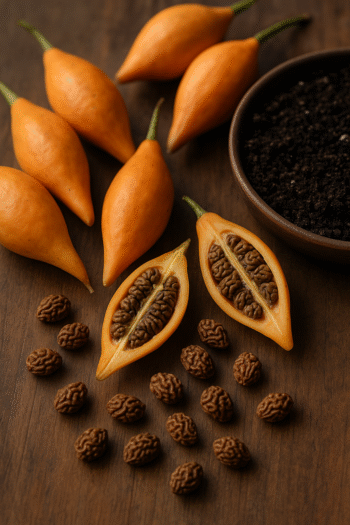
Tabernanthe iboga has a decisive advantage if you work with fresh fruit work: The seeds are still „alive“ (recalcitrant), have a high residual moisture content and germinate much more reliably on average than seeds that have been stored for a long time and dried out. The keys to success are clean preparation, constant heat (24-28 °C), high humidity (70-90 %) and patience (germination usually 2-12 weeks, sometimes longer).
Tip: Work quietly and cleanly, reduce germination - fresh seeds are robust, but susceptible to mold if pulp remains.
2. species profile (botanical & origin)
- Art: Tabernanthe iboga (Apocynaceae)
- Occurrence: West/Central Africa (e.g. Gabon, Cameroon, Congo)
- Growth: Evergreen shrub (1.5-4 m), elliptical leaves, orange fruit
- Climate: Tropical-humid; permanently warm, no cold
3. seed preparation from fresh fruit
- Open the fruit promptly: Do not leave lying around. Fruit pulp promotes mold.
- Remove seeds: Use tweezers/gloves to remove the flesh completely.
- Washing: Rinse 2-3 times in lukewarm water until there are no more mucus residues.
- Gentle disinfection (optional, but recommended): 5-10 minutes in 1 % H₂O₂ or 1:10 vinegar water; then rinse thoroughly with clear water.
- Dripping & drying: Place on kitchen paper for 30-60 minutes; do not allow to dry completely.
Important: Leftover pulp is the most common source of mold. Take your time here - clean seeds = half the success.
4. pre-treatment & activation (soaking etc.)
Soaking: 24-72 h in lukewarm Water (change daily). This hydrates the seed coat and „wakes up“ the embryo. Optionally, you can soak the last 12 hours in chamomile tea (lukewarm) - mildly antimicrobial.
Optional: A 0.5-1 %iger H₂O₂ kick (15 minutes) directly before sowing reduces surface germs.
5. sowing, substrate & germination conditions
Substrate (airy & draining): 50 % fine sowing soil + 30 % perlite + 20 % quartz sand. pH ~6.0-6.5. Moisten slightly before use.
- Sowing: Lay seeds flat and cover only very thinly (max. 2-3 mm). Light germination tendency is variable; very deep placement delayed.
- Vessel: Mini greenhouse or transparent cover for 70-90 % rH.
- Temperature: ideal 25-28 °C day / ≥22 °C night; none cold snap at night.
- Light: bright, indirect (7-10 kLx). No blazing midday sun.
- Watering: Only fine spraying; strictly avoid waterlogging.
Germination window: usually 2-12 weeks. Some grains „think“ longer (up to 4-5 months). Do not discard prematurely!
6. care of the seedlings (repotting, light, fertilizer)
- Hardening: After germination, ventilate cover daily for 10-15 minutes (1st week), then gradually increase to 1-2 h, reduce RH to 60-70 %.
- Pricking/re-potting: With 2-3 true leaves in 8-10 cm pots with an airy mixture (e.g. 60 % high-quality soil + 20 % perlite + 20 % coco).
- Light & temperature: 12-14 h bright (LED 5000-6500 K), 24-28 °C; below 18 °C growth arrest.
- Fertilization: Start minimally from week 3-4 (¼ dose organic or hydro 200-300 µS), increase slightly each month. Iboga is nutrient-sensitive - „less is more“.
- Root protection: Do not allow the pot to dry out, but always allow it to dry out before watering again.
7. troubleshooting: mold, sluggishness, failures
Mold on substratetreat with spray mist 1 % H₂O₂, increase air exchange, open cover briefly 1-2 ×/day. A thin layer of quartz sand inhibits algae/mold.
No germination after 12 weeks: Be patient for another 6-8 weeks; some seeds take a long time. Check temperature constancy (min/max thermometer!).
Attenuation (falling over of seedlings)Increase hygiene, less watering, more air movement (small USB fan on low setting).
Yellow leavesmostly wetness + lack of oxygen → loose substrate, water less often, check „wet/dry“ cycles; only then light nutrients.
8. overwintering & long-term cultivation indoors
- Warm temperature all year round: Target 22-28 °C; avoid below 15 °C.
- Humidity: 50-70 % as a permanent range; 80 % ok in the short term, but note the risk of mold.
- Light in winter: Additional LED (PPFD 150-250 µmol/m²s) 12-14 h; promotes compact growth.
- Cut: Light pruning in late spring when shoots become woody.
- Repotting: every 6-12 months in slightly larger, deep pots (root shoot!).
9. legal & responsible information
Legal notice:
This article is intended solely for informational and educational purposes in the field of botany and ethnobotany. It does not constitute an instruction, recommendation or invitation to consume, ingest or otherwise use the plants or substances described.
The cultivation, possession or trade of certain plants may be subject to legal restrictions in individual countries or regions. Please inform yourself in advance about the applicable laws and regulations in your country. GardenShaman.eu declines all responsibility for improper or illegal use.
10. suitable products & materials
Note: Purely informative content. Please always observe the legal framework conditions of your country.